FACTOIDS & TRIVIA
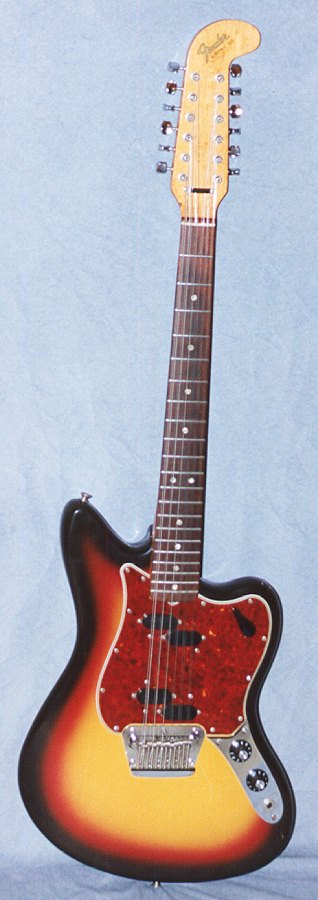
Designed by Leo Fender, the Fender Electric XII was introduced
in late 1965 with the bulk of the production taking place in 1966
before it was discontinued around 1970. Unlike its competitors’
electric 12-string models which were simply existing 6-string guitars
with six extra strings, the Fender Electric XII was a purpose-built
12-string designed to capture a part of the folk-rock
market. The headstock was a departure from Fender’s usual
Stratocaster-style shape and is sometimes referred to as the “hockey stick”
headstock. Leo Fender’s bridge design for this model
is elegantly simple, works extremely well, and is regarded by many as
one of his best designs of the 1960s. The bridge has an individual
saddle for each string making precise intonation possible. The
design is also string-through-body which helps to increase
sustain. The guitar shown here has factory "jumbo" frets which
Fender was using on some guitars made during the late-1965 to mid-1966
period. It is embossed “Special” on the back of the headstock
and on the body indicating it may have been a sales representative’s
demo guitar. It’s also unusual because it has a nitrate
(“green”) pickguard and the nitrate guards were pretty much
discontinued in 1964. Perhaps the most famous user of the
Fender Electric XII was Led Zeppelin’s Jimmy Page who used one to
record “Stairway to Heaven.”
Body: Solid, 3-piece alder
Finish: Sunburst, nitrocelluslose lacquer
Neck: 1-piece maple, bolt-on
Fingerboard: Brazilian rosewood, pearloid dot markers
Number of Frets: 21
Pickguard: Tortoise/white/black/white nitrocellulose laminate
Bridge: Fender steel, chrome
Nut: Plastic
Tuners: Fender, enclosed, chrome
Pickups: Two, Fender split coil
Controls: Master tone, master volume, 4-way rotary pick-up selector
Scale Length: 25 1/2 inches
Neck Width at Nut: 1 5/8 inches
Body Width at Lower Bout: 14 inches
Body Depth: 1 5/8 inches
Weight:
8.5 lb